
KVS NVS Interview Classes: Prepare for Questions, Demo Teaching and Personality Assessment
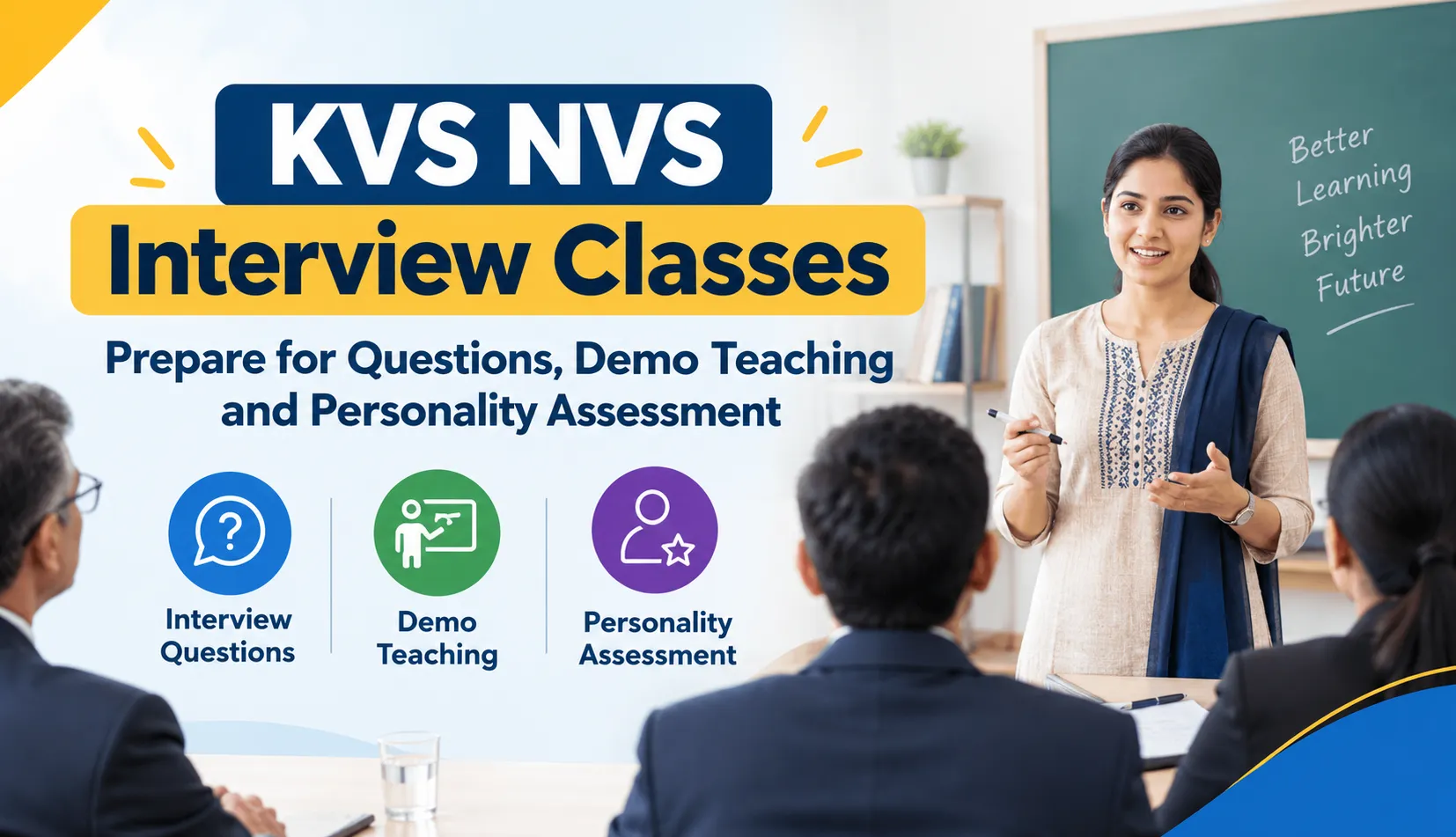
Clearing the written stage of a teaching recruitment exam is a major achievement. However, the interview stage brings a different challenge. Candidates must show subject knowledge, teaching ability, confidence, communication skills and the right attitude for a classroom.
Many candidates prepare well for written exams but feel unsure when they face an interview panel. They may know the answer but struggle to explain it clearly. Some candidates also find demo teaching difficult because they have limited experience presenting a lesson in front of an audience.
This is where KVS NVS Interview Classes can help candidates prepare in a structured way. Such preparation focuses not only on expected interview questions but also on demo teaching, classroom situations, communication and personality assessment.
Why Is the KVS NVS Interview Different From a Written Exam?
A written exam mainly tests what you know. An interview looks at how you use that knowledge and communicate it.
During the interview stage, candidates may need to demonstrate:
- Subject knowledge
- Teaching approach
- Communication skills
- Classroom management
- Confidence
- Problem-solving ability
- Awareness of educational practices
- Professional behaviour
- Ability to handle classroom situations
The panel may ask a simple question and then ask a follow-up question based on your answer. Therefore, memorising prepared answers is not enough.
Candidates need to understand their subjects and explain concepts naturally.
What Do KVS NVS Interview Classes Usually Cover?
Good KVS NVS Interview Classes should prepare candidates for different parts of the selection process instead of focusing only on common interview questions.
Interview Question Practice
Candidates should practise questions related to their subject, teaching methods, educational background and professional goals.
Some common areas include:
- Tell us about yourself.
- Why do you want to become a teacher?
- Why do you want to work in KVS or NVS?
- What is your teaching approach?
- How would you handle a difficult student?
- How would you support a slow learner?
- How would you manage a diverse classroom?
- How would you make a difficult topic easier for students?
The goal is not to memorise fixed answers. Candidates should learn how to structure their thoughts and answer in a clear and confident manner.
Preparing for Subject-Based Questions
Subject knowledge remains important during a teaching interview. A candidate may face direct questions from their subject as well as questions that test how they would teach a particular concept.
For example, a mathematics candidate may be asked to explain a basic mathematical concept as if they were teaching a student. A language teacher may need to explain grammar in a simple way.
This is why KVS NVS Interview Classes should include subject-based questioning along with teaching-oriented questions.
How to Prepare Subject Questions
Start by revising the important concepts from your subject. Do not try to revise every topic at the last moment.
Focus on:
- Basic concepts
- Important definitions
- Practical applications
- Common student mistakes
- Ways to explain difficult topics
- Examples that students can understand easily
Try explaining important concepts aloud. This practice can help you identify areas where your explanation needs improvement.
Demo Teaching: A Key Part of Interview Preparation
Demo teaching can make many candidates nervous because it requires them to demonstrate their teaching skills in a limited amount of time.
The panel is not simply checking whether you know the topic. They may also observe how you present it.
A good demo lesson should have a clear beginning, middle and conclusion.
Start With a Simple Introduction
Begin by introducing the topic in a way that connects with students.
Instead of immediately giving a definition, you can start with:
- A simple question
- A daily-life example
- A short situation
- A familiar observation
This can make the lesson more engaging.
Explain the Concept Step by Step
Avoid using complicated language when a simple explanation will work.
For example, if you are teaching a scientific concept, first explain the basic idea and then move towards the technical explanation.
Use examples wherever possible. Your goal should be to make the concept easy for a student to understand.
Check Student Understanding
A strong teacher does not speak continuously.
During the demo, show how you would check whether students understand the topic. You can ask short questions, invite responses or give a simple classroom activity.
This demonstrates that you understand teaching as an interactive process.
End With a Clear Conclusion
Do not end the demo suddenly.
Briefly summarise the main points and connect them with what students may learn next. This gives your lesson a proper structure.
How KVS NVS Interview Classes Can Improve Demo Teaching
KVS NVS Interview Classes can give candidates an opportunity to practise their demo lessons before facing the actual panel.
Practice can help identify issues such as:
- Speaking too quickly
- Reading from notes too much
- Lack of eye contact
- Poor board presentation
- Unclear explanations
- Weak lesson structure
- Limited student interaction
- Poor time management
Mock demo sessions can also help candidates become more comfortable with presenting in front of others.
Preparing for Personality Assessment
The interview panel may also observe your overall personality during the interaction.
Personality assessment does not mean candidates need to act like someone else. Instead, candidates should present themselves naturally and professionally.
Focus on Communication
Speak clearly and avoid unnecessarily complicated words.
If you do not understand a question, you can politely ask the panel to repeat or clarify it. It is better to give a thoughtful answer than to rush into an unrelated response.
Show Professional Confidence
Confidence does not mean speaking loudly or trying to dominate the conversation.
A confident candidate listens carefully, takes a moment to think and gives a relevant answer.
Maintain appropriate eye contact and sit comfortably. Avoid excessive hand movements or nervous gestures.
Be Honest About What You Know
Candidates sometimes try to guess answers because they fear saying, “I don’t know.”
If you genuinely do not know something, respond honestly and professionally. You can say that you are not certain about the answer and would like to learn more about it.
This is better than providing incorrect information with confidence.
Practise Real Classroom Situations
Teaching interviews can include situation-based questions because teachers regularly face unexpected classroom challenges.
For example, the panel may ask:
- What would you do if students are not paying attention?
- How would you handle a disagreement between students?
- What would you do if a student repeatedly fails to complete assignments?
- How would you help a student who is struggling with a concept?
- How would you handle different learning levels in one classroom?
There may not always be one perfect answer. Candidates should explain their reasoning and show that they can respond calmly and responsibly.
Why Mock Interviews Matter
Reading interview questions is useful, but answering them aloud gives a different kind of practice.
Mock interviews allow candidates to experience a realistic question-and-answer environment.
During a mock session, candidates can work on:
- Answer structure
- Speaking speed
- Confidence
- Body language
- Subject knowledge
- Follow-up questions
- Situational responses
The feedback after the mock interview is equally important. Candidates should understand what they did well and what they need to improve.
This is one of the practical benefits of KVS NVS Interview Classes because candidates can prepare through repeated practice rather than relying only on self-study.
How to Make Your Interview Preparation More Effective
Joining a class alone does not guarantee good performance. Candidates also need regular personal practice.
Create a Daily Practice Routine
Spend some time every day on interview preparation.
You can divide your practice into three parts:
Interview questions: Practise answering common and subject-related questions.
Demo teaching: Select one topic and explain it within a fixed time.
Personality practice: Work on communication, confidence and body language.
Record Your Answers
Use your phone to record practice sessions.
Listen to the recording and check:
- Did you speak clearly?
- Did you repeat words?
- Was your answer too long?
- Did you answer the exact question?
- Did your explanation sound natural?
This simple activity can reveal mistakes that you may not notice while speaking.
Avoid Over-Memorising Answers
Prepared points are useful, but memorised speeches can sound unnatural.
Instead, prepare key ideas and examples. Then practise explaining them in your own words.
This approach can help you handle follow-up questions more comfortably.
What Should You Look for in Interview Preparation Classes?
Before joining KVS NVS Interview Classes, candidates should understand what the programme actually provides.
Look for preparation that includes:
- Personalised mock interviews
- Subject-based questions
- Demo teaching practice
- Situation-based questions
- Personality development
- Feedback after practice
- Communication improvement
- Interview strategy
- Multiple practice sessions
A structured approach can make preparation more organised and help candidates identify their weak areas early.
Build Confidence Through Practice
Interview confidence usually develops through preparation and repeated practice.
You do not need to know every possible question. Instead, focus on understanding your subject, developing a clear teaching approach and learning how to communicate your ideas.
Practise with different types of questions. Ask someone to interrupt with follow-up questions. Try explaining the same concept in two different ways. These small exercises can make you more flexible during the actual interview.
Prepare for the Complete Interview Experience
The KVS and NVS interview stage requires more than textbook knowledge. Candidates need to show that they can communicate, teach, manage classroom situations and respond professionally.
A complete preparation plan should therefore cover interview questions, demo teaching and personality assessment together.
With structured KVS NVS Interview Classes, candidates can practise these areas in a focused environment and understand where they need improvement.
Final Thought
The interview is an opportunity to show the panel how you can turn your knowledge into effective teaching. Focus on clear communication, practical examples, classroom awareness and genuine confidence.
Do not try to present a perfect personality. Instead, prepare well and let your teaching ability and understanding speak through your answers.
VyasaIAS can help aspirants approach their interview preparation with structured practice and focused guidance. With consistent preparation, candidates can walk into the interview with a clearer understanding of what they need to demonstrate.
Ready to strengthen your interview preparation? Build your confidence through mock questions, demo lessons, classroom scenarios and personalised feedback.
Prepare with focused KVS NVS demo teaching practice and learn how to present your subject knowledge with clarity and confidence. Start preparing for the interview stage with a structured approach that covers the areas that matter most.