
UPSC EPFO Previous Year Papers: How to Use PYQs for APFC Preparation
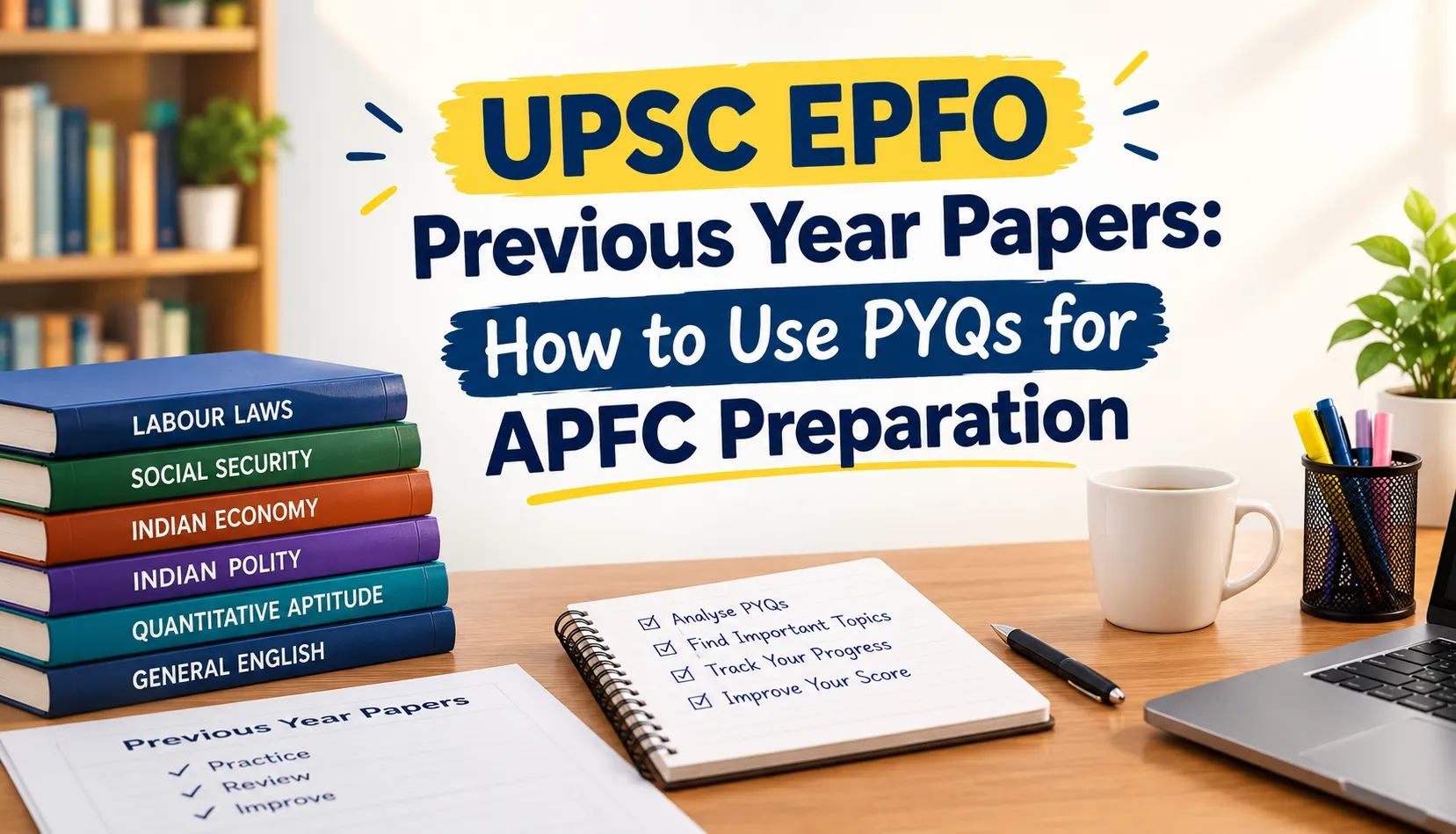
Preparing for the APFC exam requires more than reading books and making notes. You also need to understand how UPSC frames questions. This is where previous year papers become useful.
For UPSC EPFO APFC preparation, previous year question papers can help you understand the type of questions asked, the subjects covered, and the level of preparation expected. UPSC provides previous question papers through its official website, making it important for candidates to check official sources when available.
However, simply downloading PYQs is not enough. You need to use them as a study and revision tool.
Many aspirants solve a paper once, check their score, and move on. This approach misses the real value of PYQs. A better method is to study every question, understand the topic behind it, and use your mistakes to improve your preparation.
Why Previous Year Papers Matter for APFC Preparation
Previous year papers give you a practical view of the examination.
Your books tell you what you should study. PYQs show you how you may need to apply that knowledge in an exam.
For UPSC EPFO APFC preparation, PYQs can help you:
- Understand question patterns
- Identify important topics
- Test your basic concepts
- Improve question-solving speed
- Find weak areas
- Practise elimination techniques
- Understand how different subjects are tested
- Build confidence before the exam
PYQs also help you avoid studying every topic with the same level of attention.
For example, if you repeatedly struggle with labour laws, you can give that area more revision time instead of spending most of your day on topics you already understand.
Start With the Official Question Papers
Before using coaching PDFs or random question banks, check the official UPSC resources.
UPSC maintains a dedicated Previous Year Question Papers section and also provides an archive for older papers. Its recruitment-test question-paper section includes papers associated with specific posts, including EPFO recruitment.
This gives you a reliable starting point.
After collecting the relevant papers, arrange them year-wise. Keep the question paper and answer key together whenever a reliable key is available.
Do not depend on a social media post or an unofficial PDF when the official source is available.
How to Analyse a Previous Year Paper
Do not start by solving every paper repeatedly.
First, analyse one paper carefully.
Step 1: Attempt the Paper Without Help
Try the paper like a real examination.
Keep a timer and avoid checking your notes while solving.
This gives you a more realistic idea of your current preparation level.
Do not worry if your first score is low. The first attempt is mainly a diagnostic exercise.
Step 2: Check Every Answer
After completing the paper, check your answers carefully.
Do not only count your correct answers.
Divide the questions into three groups:
Correct and Confident: You knew the concept and selected the answer with confidence.
Correct but Unsure: You selected the right answer but were not fully sure.
Incorrect or Not Attempted: You either made a mistake, did not know the concept, or could not decide.
The second and third groups need more attention.
Step 3: Find the Topic Behind Every Question
This is one of the most important steps.
Suppose a question tests a particular provision of labour law. Do not simply note the correct option.
Go back to the topic and revise the relevant concept.
This turns one PYQ into a complete learning exercise.
Use PYQs to Identify Important Topics
You do not need to predict the exact questions that UPSC will ask next.
Instead, look for broader topic patterns.
For example, while analysing papers, you may find questions related to:
- Labour laws
- Industrial relations
- Social security
- Indian economy
- Indian polity
- History and culture
- General science
- Current affairs
- Quantitative aptitude
- Reasoning
- English language
- Accountancy and related areas
The exact distribution can change between examinations. Therefore, use PYQs to understand the exam’s approach, not to assume that the same questions will return.
This is an important part of effective UPSC EPFO APFC preparation.
Create a PYQ Mistake Notebook
A small mistake notebook can make your revision much easier.
Whenever you get a question wrong, write down:
- The question topic
- Why you made the mistake
- The correct concept
- Any confusing fact
- The source you used for revision
Keep the explanation short.
For example:
Topic: Social Security
Mistake: Confused two provisions
Revision Point: Write the difference between the two provisions in two or three lines.
Review this notebook every few days.
Over time, it becomes a personalised revision guide.
Use PYQs Subject-Wise
Solving complete papers is useful, but subject-wise PYQ practice can make preparation more focused.
Labour Laws and Industrial Relations
Pay close attention to concepts, provisions, definitions, and practical applications.
If a question exposes a weak area, return to your standard study material and revise that topic.
Social Security
Understand important schemes, institutions, provisions, and concepts instead of memorising isolated facts.
Try to understand how social security works in the Indian context.
Indian Polity
Revise important constitutional concepts, institutions, rights, duties, and governance-related topics.
PYQs can help you identify areas where you need stronger conceptual clarity.
Economy
Focus on basic economic concepts and their application to the Indian economy.
Connect static concepts with relevant developments when required.
Quantitative Aptitude and Reasoning
Use PYQs to improve speed as well as accuracy.
After solving a question, ask yourself whether you used the simplest method available.
English
Analyse the type of questions asked and revise grammar, vocabulary, comprehension, and usage accordingly.
Do Not Memorise Previous Year Questions
This is a common mistake.
Aspirants sometimes memorise PYQs because they expect similar questions to appear again.
That is not a reliable preparation strategy.
Instead, understand the concept behind every question.
For example, if a PYQ asks about a particular labour law provision, learn the provision and related concepts. If UPSC changes the wording or asks the same concept through a different situation, you should still be able to solve it.
This approach makes your UPSC EPFO APFC preparation stronger and more flexible.
Combine PYQs With Mock Tests
PYQs and mock tests serve different purposes.
PYQs help you understand previous examination patterns.
Mock tests help you practise under timed conditions.
Use both.
A simple approach can be:
First: Study the topic.
Second: Solve related PYQs.
Third: Review mistakes.
Fourth: Take a mock test.
Fifth: Analyse the mock test.
This cycle helps you turn passive reading into active preparation.
How Often Should You Solve PYQs?
There is no need to solve the same paper every day.
Instead, follow a revision cycle.
First Round
Solve the paper after completing the relevant topics.
Focus on understanding your mistakes.
Second Round
Return to the paper after a few weeks.
Try to solve it without looking at your previous answers.
Final Revision
Use selected questions and your mistake notes for quick revision.
The aim is not to remember the answer option. The aim is to remember the concept.
Use PYQs to Improve Time Management
A good score requires both knowledge and time management.
While solving previous papers, record how long you take.
Notice which questions consume too much time.
For example, you may know the concept but spend too long solving a calculation. Or you may spend several minutes on a difficult reasoning question.
Mark such questions.
During future practice, learn when to move on and return later.
This habit can help you use your examination time more effectively.
Build a Simple PYQ-Based Study Plan
You can include PYQs in your weekly study schedule without making preparation complicated.
Monday to Thursday
Study new concepts and revise previous topics.
Friday
Solve subject-wise PYQs from the topics studied during the week.
Saturday
Attempt a full previous year paper or a timed practice set.
Sunday
Analyse mistakes and revise weak areas.
You can change this schedule according to your preparation level.
The important point is to keep PYQ analysis regular.
Common Mistakes to Avoid
Solving Without Analysis
A score alone does not tell you why you made mistakes.
Depending Only on PYQs
Previous papers are useful, but they cannot replace complete syllabus preparation.
Ignoring Incorrect Answers
Wrong answers often show you exactly where you need more work.
Using Too Many Sources
Choose reliable books and study materials instead of collecting endless PDFs.
Memorising Options
Learn concepts instead of remembering answer choices.
Ignoring Current Preparation
Past papers show previous trends, but the upcoming examination can test topics differently.
A Better Way to Revise PYQs Before the Exam
During the final stage of UPSC EPFO APFC preparation, focus on quality rather than quantity.
Do not try to solve every available question bank.
Revise:
- Questions you got wrong
- Questions you found confusing
- Important recurring concepts
- Labour law topics that need revision
- Social security concepts
- Difficult numerical questions
- Important current topics
- Your personal mistake notes
This will make your final revision more organised.
Final Thought
Previous year papers can become one of the most useful tools in your APFC preparation when you use them correctly. They can show you where your preparation stands and help you understand how to approach objective questions.
But remember that PYQs are a guide, not a prediction of the next paper. UPSC can change question framing, topics, and difficulty.
Use previous papers with your syllabus, standard study material, current affairs preparation, and regular mock tests.
For serious UPSC EPFO APFC preparation, focus on understanding concepts instead of simply completing a fixed number of papers. Analyse your mistakes, revise weak areas, and practise questions under time limits.
With a structured approach, PYQs can help you study smarter and make your preparation more focused.
VyasaIAS supports aspirants with structured exam preparation and guidance designed to help them approach competitive examinations with greater clarity.
Looking for previous year papers to practise? Download a reliable upsc epfo apfc previous year question paper pdf and use it as part of your regular revision plan.
Do not stop after solving the paper. Check every mistake, revise the related concept, and attempt the questions again after some time.
Start with one paper today and turn every mistake into a revision point for your APFC preparation.