
UPSC EPFO Coaching in Delhi vs Self-Study: 7 Factors to Consider Before Deciding
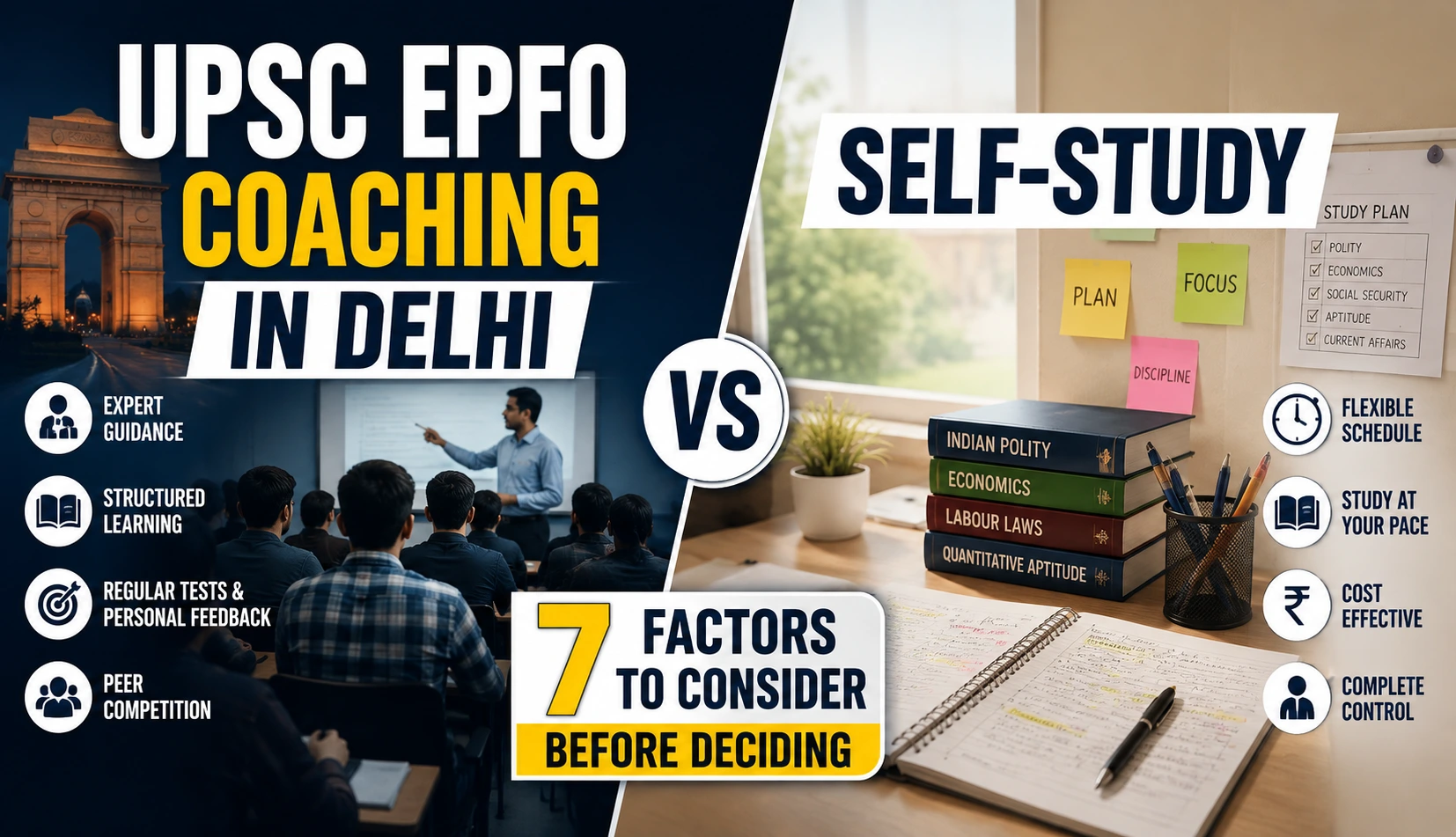
Preparing for the UPSC EPFO exam requires a clear strategy, regular practice and a good understanding of the syllabus. Many aspirants in Delhi face an important question before starting their preparation: should they join a coaching institute or prepare through self-study?
There is no single answer that works for every student. Some aspirants learn better with classroom guidance, while others prefer to create their own study schedule and prepare independently.
Before deciding, it is important to understand how to prepare for UPSC EPFO exam based on your learning style, available time, budget and preparation level.
This guide compares UPSC EPFO coaching in Delhi with self-study and explains seven important factors you should consider before making your decision.
1. Understanding the UPSC EPFO Syllabus
The first step in preparation is understanding what you need to study.
The UPSC EPFO examination covers multiple areas, including General English, Indian Freedom Struggle, Current Events and Developmental Issues, Indian Polity and Economy, General Accounting Principles, Industrial Relations and Labour Laws, General Science and Computer Applications, and other relevant areas.
Coaching Approach
A coaching institute usually provides a structured syllabus plan. Teachers divide topics into classes and may follow a fixed preparation schedule.
This can help students who find it difficult to decide what to study first.
Self-Study Approach
With self-study, you need to understand the syllabus yourself and divide it into manageable sections.
You can choose your own books, online resources, newspapers, mock tests and study materials.
If you have strong planning skills, self-study can work very well.
What Should You Choose?
Ask yourself whether you can create and follow a realistic study plan.
If you regularly struggle with planning, coaching may provide the structure you need.
If you already know how to prepare for UPSC EPFO exam and can follow a timetable consistently, self-study may be enough.
2. Your Level of Discipline
Discipline plays a major role in competitive exam preparation.
You may have excellent books and study materials, but they will not help if you do not study regularly.
Coaching Provides External Structure
Coaching classes create fixed schedules. You need to attend classes, complete assignments and follow the preparation plan.
This external structure can help students stay consistent.
Self-Study Requires Strong Discipline
Self-study gives you complete freedom, but that freedom also comes with responsibility.
You decide when to study, what to study and how much time to spend on each topic.
If you frequently postpone your study sessions, self-study can become difficult.
Think About Your Study Habits
Look at your past preparation habits.
If you can sit down every day and complete planned tasks without someone reminding you, self-study may suit you.
If you need regular deadlines and classroom interaction, coaching may be a better option.
3. Quality of Study Material
Good study material can save time and make preparation more focused.
What Coaching Institutes Offer
Many coaching institutes provide notes, topic-wise material, practice questions and mock tests.
Teachers may also suggest books and resources based on the examination requirements.
This can reduce the time you spend searching for study materials.
What Self-Study Offers
Self-study gives you the freedom to choose your own resources.
You can use standard books, government publications, current affairs sources, previous-year papers and online educational resources.
However, you need to identify reliable sources yourself.
Which Option Is Better?
If you feel confused by the number of available resources, coaching material can make preparation easier.
If you already know which books and sources to use, you may not need a large amount of additional material.
A key part of learning how to prepare for UPSC EPFO exam is knowing what to study and what to avoid.
4. Doubt Solving and Expert Guidance
Competitive exam preparation often creates questions that are difficult to solve alone.
Advantage of Coaching
In a classroom or online coaching environment, you can ask teachers to explain difficult concepts.
An experienced teacher can also point out common mistakes and suggest ways to improve your preparation.
This guidance can be particularly useful for subjects such as labour laws, industrial relations, accounting and other technical areas.
Challenge of Self-Study
Self-study does not mean you cannot solve doubts.
You can use reference books, online resources, discussion forums and educational videos.
However, finding a clear answer can sometimes take more time.
Consider Your Learning Style
If you understand concepts better through discussion and explanation, coaching may offer an advantage.
If you enjoy researching and solving problems independently, self-study can work well.
5. Mock Tests and Previous-Year Questions
Practice is an important part of UPSC EPFO preparation.
Reading the syllabus is not enough. You also need to understand the type of questions asked and improve your time management.
Coaching and Test Practice
Coaching programmes often include regular tests, quizzes and mock examinations.
These tests can help you measure your progress and identify weak areas.
Teachers may also discuss answers and explain why certain options are correct or incorrect.
Self-Study and Mock Tests
Self-study students can also access online test series and previous-year papers.
The key is to use them regularly rather than taking tests only near the examination.
Try to analyse every mock test. Do not focus only on your score.
Look at:
- Questions you answered incorrectly
- Questions you guessed
- Topics that took too much time
- Topics you skipped
- Repeated mistakes
This analysis can improve your preparation significantly.
6. Time and Budget
Your available time and budget can influence your decision.
Coaching Costs Money
Joining a coaching institute involves fees and may also involve travel costs if you attend physical classes.
However, coaching can save preparation time by giving you organised material, scheduled classes and guided revision.
Self-Study Can Be More Flexible
Self-study can reduce coaching expenses.
You can choose affordable books, online resources and test series according to your budget.
It also allows you to study at your own pace.
Consider Your Daily Schedule
If you are a full-time student, you may have more flexibility.
Working aspirants may need a different approach.
Before deciding, calculate how many hours you can realistically study every day.
A plan that looks good on paper but does not fit your daily life will be difficult to follow.
7. Your Current Preparation Level
Your existing knowledge should also influence your decision.
Beginners May Benefit From Coaching
If you are preparing for the UPSC EPFO exam for the first time and do not understand the syllabus, coaching can provide a useful starting point.
A structured programme can help you understand subjects, preparation techniques and test strategies.
Experienced Aspirants May Prefer Self-Study
If you have already prepared for competitive exams, you may understand how to organise your studies.
You may only need selected resources, current affairs updates and a good test series.
In that situation, joining a complete coaching programme may not always be necessary.
Coaching vs Self-Study: Which Is Better?
Both approaches can work.
The better option depends on your individual needs.
Choose Coaching If You:
- Need a fixed study schedule
- Want teacher guidance
- Prefer classroom learning
- Need regular doubt-solving support
- Find it difficult to select study materials
- Want structured mock tests and revision
Choose Self-Study If You:
- Have strong discipline
- Can create your own timetable
- Know which resources to use
- Prefer independent learning
- Have limited budget
- Can regularly analyse your own performance
You can also combine both approaches.
For example, you can join a coaching programme for difficult subjects while using self-study for current affairs, revision and practice.
How to Prepare for UPSC EPFO Exam Effectively
Regardless of whether you choose coaching or self-study, your preparation should follow a practical routine.
Start With the Syllabus
Read the complete syllabus before choosing books or classes.
Break large topics into smaller sections.
Use Previous-Year Questions
Previous-year questions can help you understand the examination pattern and identify important areas.
Make Short Revision Notes
Do not keep creating lengthy notes.
Focus on important facts, concepts, formulas, laws and information that you need to revise regularly.
Follow Current Affairs
Keep up with important national and economic developments.
Choose one or two reliable sources instead of reading everything available online.
Take Regular Mock Tests
Mock tests can improve speed, accuracy and confidence.
Always review your mistakes after every test.
Revise Regularly
Revision should be part of your weekly routine.
Studying a topic once does not guarantee that you will remember it during the examination.
A balanced preparation strategy is one of the most important parts of understanding how to prepare for UPSC EPFO exam successfully.
Can You Prepare for UPSC EPFO Without Coaching?
Yes, self-study is possible.
Many aspirants successfully prepare for competitive examinations without joining traditional coaching.
However, self-study requires planning, consistency and reliable resources.
If you choose this route, create a realistic timetable and set weekly targets.
Track your progress instead of simply counting study hours.
For example, instead of saying, “I studied for eight hours,” ask yourself, “What did I complete today?”
This approach makes your preparation more result-focused.
Final Thoughts
Choosing between coaching and self-study is a personal decision. There is no shortcut that guarantees success.
The right approach depends on your preparation level, learning style, available time, budget and ability to stay disciplined.
Whether you choose coaching, self-study or a combination of both, focus on understanding the syllabus, practising questions, revising regularly and analysing your performance.
If you are still unsure about how to prepare for UPSC EPFO exam, start by assessing your strengths and weaknesses. This will help you choose a preparation method that fits your needs.
VyasaIAS can support aspirants who want structured guidance, expert instruction and focused preparation for competitive examinations.
If you prefer guided learning and want a structured preparation environment, explore UPSC EPFO Classes Delhi and choose a programme that matches your preparation goals.
Remember, the best coaching programme cannot replace consistent effort. Your daily preparation, practice and revision will ultimately make the difference.