

Preparing for the APFC Recruitment Test requires more than covering the syllabus. You also need to understand how to attempt questions, manage your time and avoid unnecessary negative marks. A strong preparation strategy can help you make better decisions during the examination.
For candidates preparing for UPSC EPFO, understanding the marking scheme is especially important. The APFC Recruitment Test has objective-type questions, and an incorrect answer attracts a negative mark. Therefore, attempting questions without enough confidence can affect your overall score.
The UPSC EPFO Notification 2026 provides important information about the recruitment process, vacancies, eligibility and examination. Candidates should always check the latest official information before making final preparation decisions.
Download UPSC EPFO APFC Notification PDFUnderstand the APFC Negative Marking System
Before planning your attempt strategy, understand how marks are awarded.
As per the examination pattern, the APFC Recruitment Test carries 300 marks with 120 questions. Candidates get two hours to complete the paper. Each question carries 2.5 marks, while an incorrect answer leads to a deduction of one-third of the marks assigned to that question.
| Attempt | Marks |
| Correct answer | +2.5 |
| Incorrect answer | -0.83 approximately |
| Unattempted question | 0 |
| Total questions | 120 |
| Maximum marks | 300 |
| Exam duration | 2 hours |
This means a few careless attempts can reduce the benefit of your correct answers.
For example, if you answer 10 questions incorrectly, you can lose approximately 8.3 marks. That is why accuracy matters as much as the number of questions you attempt.
Do Not Try to Attempt Every Question
One common mistake among aspirants is trying to answer every question.
You may feel that attempting more questions will automatically increase your score. However, negative marking changes this calculation.
Suppose you are unsure about five questions. If you randomly select options and get them wrong, you lose marks. If you leave them unanswered, you do not lose any marks.
Your objective should therefore be to find the right balance between attempts and accuracy.
Follow the Three-Level Attempt Method
Divide questions into three categories during the examination.
| Question Type | What to Do | Priority |
| Very familiar | Answer confidently | First |
| Partially familiar | Use elimination and reasoning | Second |
| Completely unfamiliar | Review later or leave | Last |
This simple approach can help you avoid wasting valuable time on difficult questions.
Attempt the Easy Questions First
When the examination begins, do not immediately start with the most difficult question.
Look for questions where you know the answer clearly. Solve them first.
This approach gives you several advantages:
- You collect easier marks quickly.
- You build confidence.
- You save time for difficult questions.
- You reduce the risk of getting stuck early.
- You get a better idea of how much time remains.
Once you complete the easy questions, move towards questions that require more thought.
Use Option Elimination Carefully
You may come across questions where you do not know the answer immediately. Do not guess blindly.
First, read all the options.
Try to eliminate options that are clearly incorrect. Your subject knowledge may help you narrow the possibilities.
For example, if you can confidently eliminate two options from a four-option question, you have improved your chances of selecting the correct answer. However, do not treat elimination as a guarantee. Use it along with your understanding of the topic.
Read Every Question Carefully
Many negative marks come from mistakes that have nothing to do with a lack of knowledge.
A candidate may know the concept but misunderstand what the question asks.
Pay attention to words such as:
- Not
- Incorrect
- Correct
- Except
- Only
- Most appropriate
- All of the above
- Both statements
Read the complete question before looking at the options.
If you rush through the question, you may select an answer that would have been obviously wrong if you had read it carefully.
Improve Accuracy Through Mock Tests
Mock tests are an important part of UPSC EPFO preparation. But simply taking mock tests is not enough.
You should analyse your performance after every test.
Ask yourself:
- How many questions did I attempt?
- How many answers were correct?
- How many were wrong?
- Why did I make each mistake?
- Which subject caused the most errors?
- Which questions consumed too much time?
- Did I change any correct answers unnecessarily?
Maintain a mistake notebook and record important errors.
For example, if you repeatedly make mistakes in Labour Laws, revise the relevant concepts before taking another test.
This process helps you turn mistakes into learning opportunities.
Manage Your Two-Hour Exam Time
Time management can make a major difference in the APFC Recruitment Test.
You have a fixed amount of time to solve 120 questions. Spending several minutes on one difficult question can create problems later.
Use a simple three-round approach.
Round One: Quick and Easy Questions
Answer questions that you know immediately.
Do not stop for long on difficult questions.
Round Two: Moderate Questions
Return to questions that require calculation, reasoning or careful reading.
Use your subject knowledge and elimination skills.
Round Three: Difficult Questions
Use your remaining time to review difficult or marked questions.
At this stage, decide whether you have enough information to attempt them.
Avoid Changing Answers Without a Reason
Another common mistake is changing an answer simply because you become doubtful during the final review.
If you selected an answer confidently and later feel uncertain, do not change it without a clear reason.
Change your answer when you:
- Notice that you misread the question.
- Remember a relevant fact.
- Identify a clear calculation error.
- Realise that you misunderstood the concept.
Avoid changing answers only because another option suddenly looks attractive.
Revise Important Subjects Regularly
The UPSC EPFO Notification 2026 should remain an important reference during your preparation. Along with understanding the recruitment details, candidates should create a revision plan based on the prescribed examination syllabus.
Depending on the applicable syllabus, your preparation can cover areas such as:
- Indian Polity and Economy
- General Science
- General Mental Ability
- Quantitative Aptitude
- English Language
- Labour Laws
- Industrial Relations
- Social Security
- Accountancy and Auditing
- Insurance
- Computer Awareness
- Current Affairs
Do not wait until the last few days to revise these subjects.
Short and regular revision sessions can help you retain important concepts for longer.
Common Mistakes That Can Reduce Your Score
Even well-prepared candidates can lose marks because of avoidable mistakes.
Blind Guessing
Do not select an option simply because you have no idea about the question.
Ignoring Negative Marking
Always remember that an incorrect answer can reduce your score.
Focusing Only on Attempt Numbers
A high number of attempts does not necessarily mean a high score. Accuracy matters.
Spending Too Much Time on One Question
If you cannot solve a question after reasonable effort, move ahead and return to it later.
Skipping Mock-Test Analysis
Your score tells you how you performed. Your mistakes tell you how to improve.
A Simple Strategy to Maximize Your Score
For UPSC EPFO APFC preparation, focus on building a strategy that you can actually follow during the examination.
Use this simple checklist:
|
Preparation Area |
What You Should Do |
| Syllabus | Cover every important subject |
| Revision | Revise regularly |
| Practice | Solve MCQs consistently |
| Mock tests | Take tests under exam-like conditions |
| Mistakes | Maintain an error notebook |
| Accuracy | Reduce careless attempts |
| Time management | Practise completing papers within two hours |
| Guessing | Avoid blind guesses |
The purpose of this strategy is not to make you attempt every question. It is to help you make the best possible use of your preparation.
Use the Latest Recruitment Information
Aspirants should keep checking official recruitment information because examination details, dates and other requirements can change.
The UPSC EPFO Notification 2026 can help candidates understand the recruitment details and plan their preparation accordingly. However, always verify final examination information through the official UPSC sources.
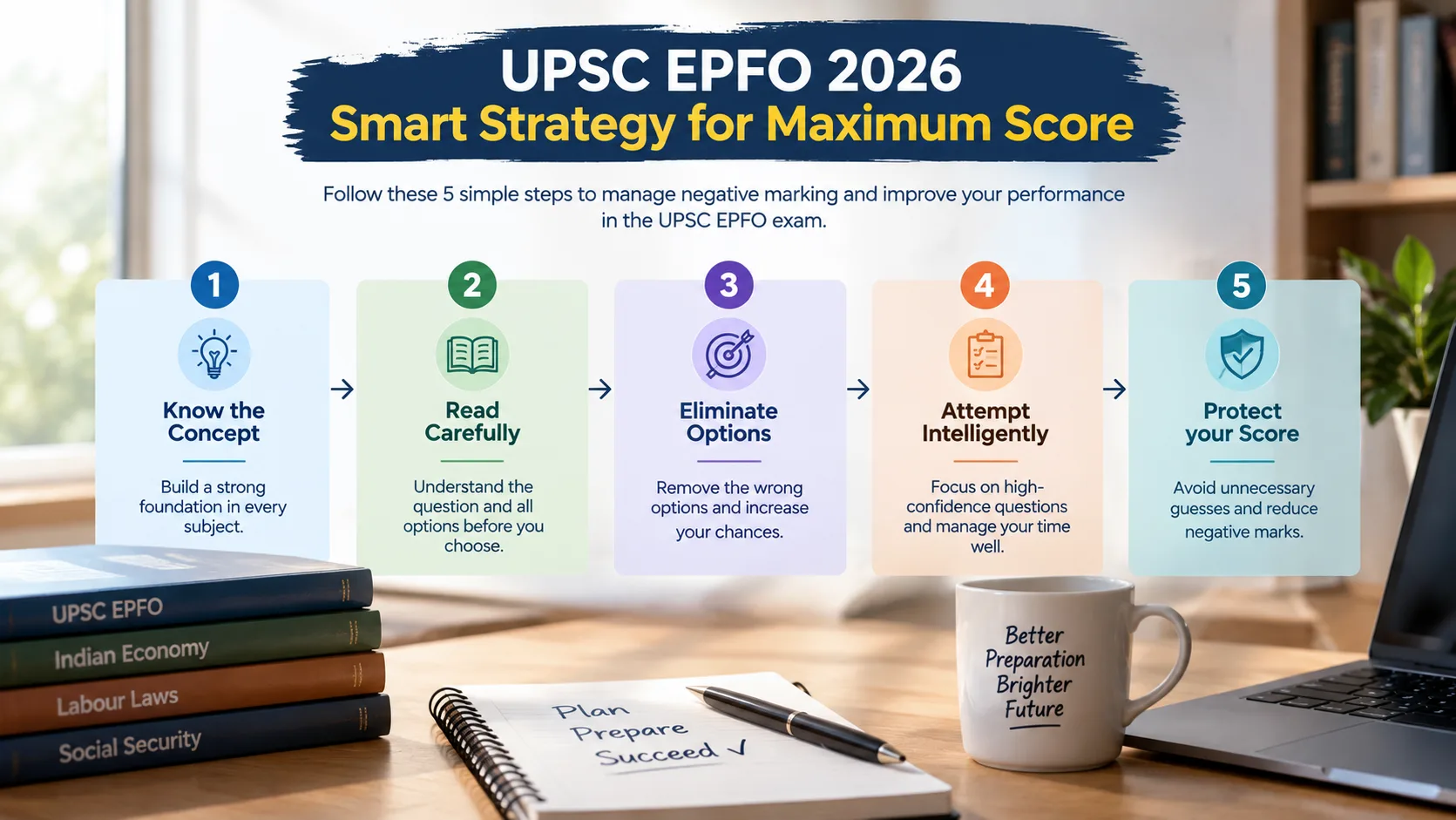
Final Thoughts
Avoiding negative marks is not about leaving most questions unanswered. It is about making sensible decisions.
A well-prepared candidate should know when to attempt a question, when to use elimination and when to move on. Regular mock tests can help you develop this judgement before the actual examination.
For UPSC EPFO aspirants, the ideal approach is to combine strong subject knowledge with accuracy, time management and disciplined question selection.
Keep revising, practise regularly and analyse your mistakes honestly. With a clear strategy, you can reduce avoidable errors and use your examination time more effectively.
Vyasa IAS can help aspirants build a structured preparation approach for UPSC EPFO, with exam-focused learning, practice and guidance.
Contact Us
Address: 111,First Floor, Grover Chamber, Opposite Metro Pillar 109, Karol Bagh, Delhi, India 110005
Phone: +91 9266105859 |+91 8851628134
Mail: vyasaias.info@gmail.com