

Cracking the UPSC EPFO exam is not only about attempting as many questions as possible. Your final result depends on two things that many candidates underestimate: how carefully you handle negative marking and how well you perform in the interview.
For candidates preparing for the UPSC EPFO 2026 recruitment, understanding the selection process can make preparation much more focused. A candidate who knows the syllabus but loses marks through unnecessary guesses can fall behind. Similarly, a candidate with a good written score can improve their final position with a strong interview.
The current UPSC recruitment information lists the Assistant Provident Fund Commissioner (APFC), EPFO recruitment under Special Advertisement No. 52/2025.
This guide explains the selection process in simple terms and shows how every mark can matter.
Download UPSC EPFO APFC Notification PDFUPSC EPFO 2026 Selection Process: Stages, Scores and Merit Explained
The UPSC EPFO selection process consists mainly of two important stages:
- Recruitment Test (RT)
- Interview
The Recruitment Test is an objective-type examination. Candidates who perform well enough in the written test are shortlisted for the interview.
The final merit is then prepared by considering both the Recruitment Test and interview performance. For APFC, the commonly notified weightage is 75% for the Recruitment Test and 25% for the interview. The Recruitment Test carries 300 marks, while the interview carries 100 marks.
In simple terms:
Recruitment Test = 75% of the final selection
Interview = 25% of the final selection
This means you cannot afford to ignore either stage.
How Negative Marking Affects Your UPSC EPFO Score
Negative marking is one of the biggest factors that can affect your UPSC EPFO score.
The Recruitment Test follows a negative-marking system in which one-third of the marks assigned to a question is deducted for an incorrect answer.
At first, one-third may not sound like a major penalty. But when several questions are answered incorrectly, the marks can quickly add up.
For example, suppose a question carries 2.5 marks.
If your answer is correct:
+2.5 marks
If your answer is incorrect:
-0.83 marks approximately
Now imagine you answer 10 questions incorrectly.
You could lose approximately:
10 × 0.83 = 8.3 marks
That is a significant difference in a competitive examination where candidates may be separated by only a few marks.
Should You Attempt Every Question in UPSC EPFO?
No. This is one of the most important lessons for UPSC EPFO 2026 preparation.
Some candidates believe that attempting more questions automatically means getting a higher score. That is not necessarily true when negative marking is involved.
Suppose you are completely unsure about a question. Randomly selecting an option can result in a negative mark.
Instead, learn to distinguish between:
- Questions you know confidently
- Questions where you can eliminate one or two options
- Questions where you have no idea
The first category should be your priority.
The second category can be attempted carefully because option elimination may improve your chances.
The third category should be approached with caution.
Your objective should not be maximum attempts. It should be the maximum net score.
A Simple Example of Negative Marking
Imagine two candidates have the following results:
| Candidate | Correct | Incorrect | Net Score* |
| Candidate A | 90 | 20 | Higher |
| Candidate B | 95 | 35 | Potentially lower |
*Actual scores depend on the notified question/mark structure.
Candidate B attempted more questions and got five more correct answers. However, the additional incorrect answers also resulted in more negative marks.
This is why accuracy is extremely important in UPSC EPFO.
Instead of blindly increasing your attempts, work on improving:
- Concept clarity
- Question reading
- Option elimination
- Time management
- Accuracy under pressure
UPSC EPFO 2026: From Fewer Mistakes to Better Scores
The best way to control negative marking is to practise under realistic exam conditions.
Start taking full-length mock tests regularly. After every test, don’t simply look at your score.
Divide your mistakes into three categories:
1. Knowledge Mistakes
You did not know the answer.
These questions show you what topics need more study.
2. Silly Mistakes
You knew the answer but marked the wrong option.
These mistakes usually happen because of:
- Reading too quickly
- Misunderstanding “not” or “incorrect”
- Calculation errors
- Changing a correct answer unnecessarily
3. Guessing Mistakes
You had little or no idea but attempted the question anyway.
These mistakes are particularly important because they can directly reduce your score through negative marking.
Keep a simple mistake notebook and review it regularly.
UPSC EPFO Interview: How It Impacts Your Final Selection
Many candidates focus almost entirely on the written examination and start thinking about the interview only after receiving the shortlist.
That can be a mistake.
The UPSC EPFO interview carries 25% weightage in the final selection for APFC, with the Recruitment Test accounting for the remaining 75%.
That means a good interview can make a meaningful difference to your final position.
For example, imagine two candidates have similar Recruitment Test scores.
Candidate A performs poorly in the interview.
Candidate B performs strongly and demonstrates:
- Clear communication
- Knowledge of EPFO
- Understanding of labour and social-security issues
- Confidence
- Professional behaviour
- Awareness of current affairs
Candidate B may gain an important advantage in the final merit list.
UPSC EPFO Interview: What Can Candidates Expect?
The interview is not simply another version of the written examination.
The panel may want to understand your personality, communication skills, subject knowledge and awareness of issues connected with the position.
You should be prepared to discuss areas such as:
EPFO and Social Security
Understand what EPFO does and why provident fund and social security are important for employees.
Labour Laws and Employment
Be familiar with major concepts related to labour, employment, workers’ rights and social security.
Current Affairs
Follow important national and economic developments, particularly issues related to employment, labour, social security and the Indian economy.
Your Educational Background
The interview panel may ask questions connected with your graduation or professional background.
Be ready to explain your subjects in simple language.
Your Personal Background
Questions may also come from your application, education, work experience, interests and career choices.
The key is to answer honestly and confidently rather than trying to memorise complicated responses.
Written Score vs Interview Score: What Matters More?
The simple answer is: both matter, but the written test carries greater weight.
Since the Recruitment Test accounts for 75% and the interview 25%, your primary focus should remain on scoring strongly in the written examination.
However, this does not mean the interview can be ignored.
Think of the selection process like this:
Strong written score + strong interview = best position
Strong written score + weak interview = missed opportunity
Weak written score + strong interview = difficult to recover
Therefore, prepare for the interview after building a strong written-test foundation rather than treating it as something completely separate.
UPSC EPFO 2026: A Smarter Way to Prepare
A balanced preparation strategy can make the process easier.
Step 1: Understand the Official Pattern
Start by reading the latest UPSC EPFO Notification 2026 and understanding the Recruitment Test, syllabus, marking scheme and selection rules.
Do not depend entirely on old YouTube videos or previous-year articles because recruitment rules and vacancy details can change from one cycle to another.
Step 2: Build Your Core Concepts
Study each subject systematically instead of jumping between random topics.
Create short revision notes for difficult concepts and regularly revise them.
Step 3: Practise Previous-Year Questions
Previous-year questions can help you understand the difficulty level and style of questions.
They also show you where you are making repeated mistakes.
Step 4: Take Mock Tests
Mock tests are particularly useful for controlling negative marking.
After every mock, calculate:
Accuracy = Correct Answers ÷ Total Attempts × 100
If your attempts are high but accuracy is low, don’t simply attempt more questions. Work on improving accuracy first.
Step 5: Prepare for the Interview Early
Once your written preparation becomes stable, start following important EPFO, labour, social-security and economic developments.
Practise explaining concepts in your own words.
EPFO APFC Courses: Are They Worth It for Preparation?
For candidates who prefer structured preparation, EPFO APFC courses can provide a more organised study path.
A good course can help bring together:
- Syllabus coverage
- Concept-based classes
- Mock tests
- Previous-year questions
- Revision material
- Practice exercises
- Current affairs preparation
However, joining a course alone does not guarantee success. What matters is how consistently you use the material and analyse your performance.
If you are comparing epfo apfc courses, look beyond the number of videos or study materials offered. Check whether the course provides sufficient practice, updated content, mock tests and revision support.
UPSC EPFO 2026: What to Focus on Before the Exam
The UPSC EPFO exam rewards candidates who can balance knowledge with accuracy.
Don’t enter the examination hall with the mindset of attempting every question. Enter with a plan.
Your approach should be:
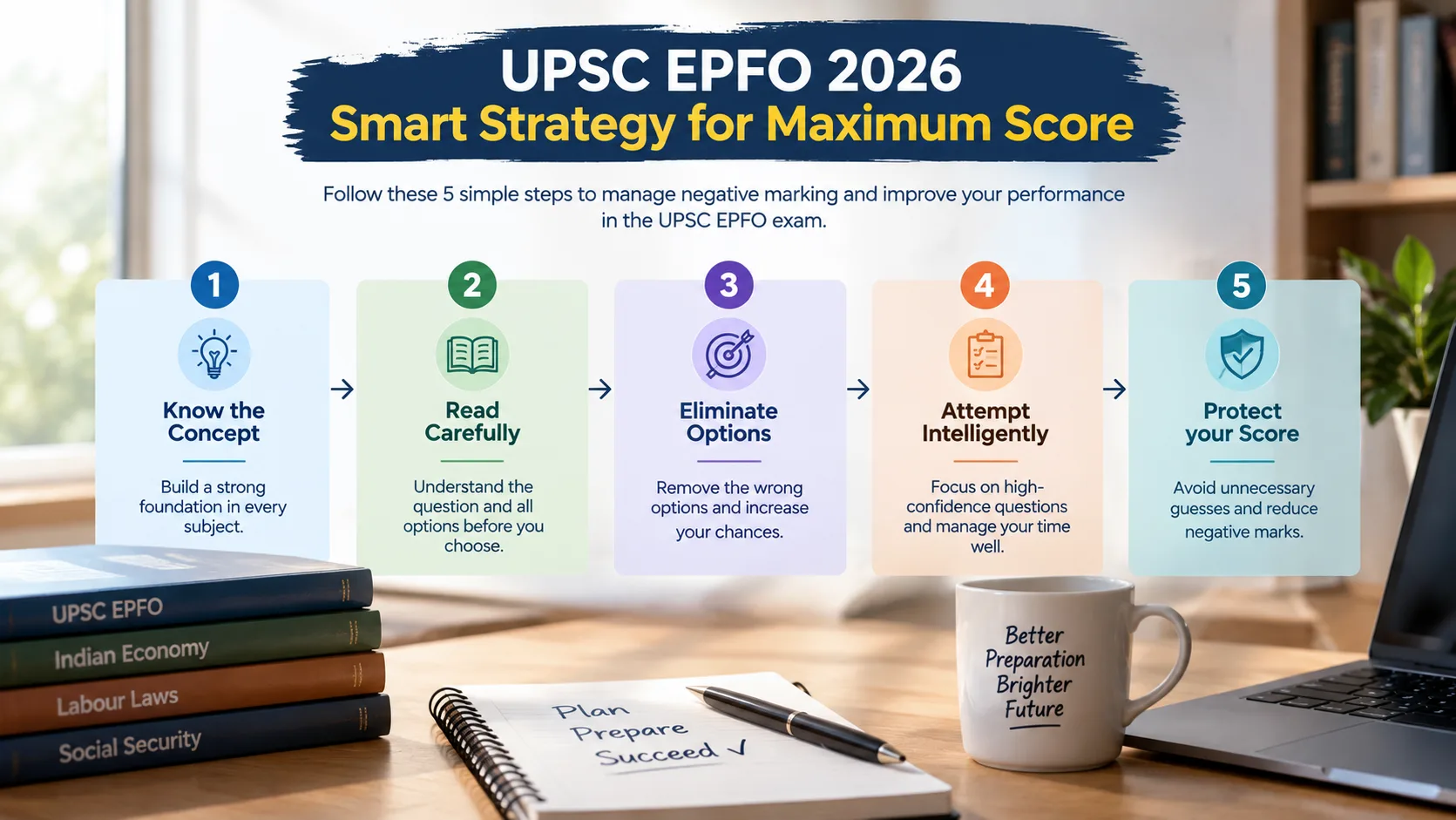
At the same time, don’t wait until the last moment to think about the interview. Since the interview contributes 25% to the final selection for APFC, good communication, confidence and awareness can make a meaningful difference.
Ready to Start Your UPSC EPFO Preparation?Contact Us
Address: 111,First Floor, Grover Chamber, Opposite Metro Pillar 109, Karol Bagh, Delhi, India 110005
Phone: +91 9266105859 |+91 8851628134
Mail: vyasaias.info@gmail.com